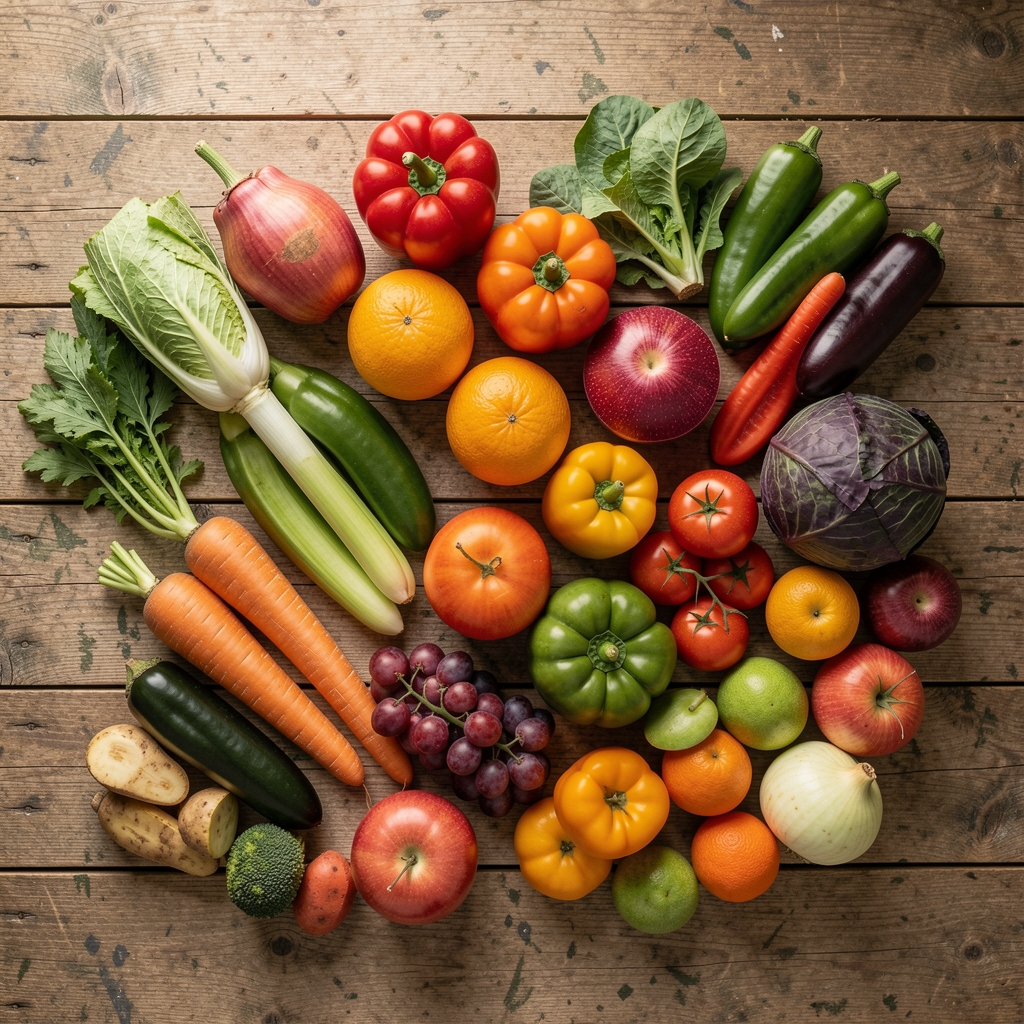
For a long period in the history of the domestic kitchen, the produce available at any given moment was simply what the season permitted. Broad beans appeared in May. Squash arrived in October. The meal assembled itself around what was present rather than what was desired. There was no particular virtue in this arrangement — it was simply the condition of the market. And yet, nutritionally speaking, the outcome was often more varied than what many households achieve today, despite year-round access to every vegetable imaginable.
This is not a call to nostalgia. It is an observation: the dietary logic embedded in seasonal rotation was not consciously designed, but it worked. A plate that followed the calendar received leafy greens in the colder months, when root vegetables provided substance, and lighter preparations in the warmer ones, when cucumbers and courgettes and tomatoes needed very little done to them. The body encountered a range of fibre types, a variety of micronutrient profiles, and textures that shifted with the outdoor world.
The Nutritional Argument for Seasonal Produce
Published nutritional research has noted repeatedly that the micronutrient content of produce begins to decline from the moment of harvest. The longer a vegetable travels — from a field in a country with different seasons to a supermarket refrigerator to a household kitchen — the more certain water-soluble nutrients have had opportunity to degrade. This is not a dramatic difference in many cases, and it does not mean that out-of-season vegetables are without value. It does mean, however, that a courgette bought from a local market in July carries something that the same courgette shipped from a distant growing region in January does not fully replicate.
Seasonal purchasing, where it is available, therefore tends to coincide with fresher produce. And freshness, in this context, is a nutritional variable as much as a sensory one. A fibre-rich diet built on locally sourced, in-season vegetables tends not because the sourcing is principled but because the vegetables are closer to their optimal state.
How the Seasonal Plate Changes the Weekly Routine
The most immediate effect of committing to seasonal produce in meal planning is the disappearance of certain questions. When you do not attempt to source whatever is craved regardless of season, the weekly menu tends to organise itself around a narrower but more concentrated range of options. This is not a restriction in the dietary sense — it is a simplification of the planning process.
In autumn, the kitchen gravitates toward roasted roots: parsnips, beetroot, celeriac, sweet potato. Soups and warm grain salads become the default format. In spring, asparagus and spring greens appear and the plate lightens accordingly — the preparations require less time, less heat, less complexity. The cook becomes fluent in the texture and behaviour of fewer vegetables, which tends to produce better outcomes than a poorly understood range of twelve.
The plate that follows the season does not demand discipline. It asks only that the shopper arrive at the market and observe what has arrived there first.
Meal preparation under this model is also more economical. In-season produce is typically lower in cost, and the reduced need to track a long list of ingredient types simplifies the grocery planning process. A household that commits to three or four core vegetables per season and builds meals around them tends to waste less and spend less while consuming a more nutrient-dense selection.
Practical Notes on Seasonal Integration
The first practical step is simply attending a farmers' market once per fortnight and purchasing whatever occupies the most prominent table at the largest stall. Market vendors do not lead with what is out of season. The largest display represents the harvest currently available. From there, the weekly menu follows.
For households that rely primarily on supermarkets, the seasonal logic can still be applied approximately. Most major supermarkets now label country of origin on fresh produce. Where there is a choice between the same vegetable grown domestically and the same grown on a distant continent, the domestic option is likely to be fresher and — during its natural season — better priced.
The food journal is a useful instrument here. Noting which vegetables appeared on the plate during which weeks of the year, together with brief observations on quality, creates a seasonal record that can inform the following year's grocery planning. After two or three years of such records, the household has a practical seasonal calendar specific to its own local market — a document far more useful than any generic nutritional guide.
Vegetables, Fibre, and the Gut Environment
A rotating seasonal plate is, almost incidentally, a fibre-rich diet. Leafy greens, root vegetables, legumes that peak in autumn, and brassicas that come into their own in winter all contribute meaningfully to daily fibre intake. Nutritional research consistently identifies adequate dietary fibre as a foundation of digestive wellbeing, with benefits that extend to sustained energy levels and more stable post-meal responses.
The gut-friendly character of a vegetable-rich seasonal plate arises not from any single ingredient but from variety over time. Different fibre types — soluble and insoluble, fermentable and non-fermentable — are found in different plant families. A plate that rotates through the seasons tends, without deliberate planning, to deliver this variety. The courgette and tomato of summer, the kale and leek of winter, the broad bean and asparagus of spring — each contributes something the others do not.
The Active Lifestyle Connection
For those engaged in regular physical activity, the seasonal plate carries an additional relevance. The energy requirements of an active lifestyle are better supported by whole, nutrient-dense foods than by calorically equivalent processed alternatives. Seasonal vegetables, prepared simply — steamed, roasted, incorporated into grain bowls — provide the carbohydrate and micronutrient substrate that supports consistent daily activity without the calorie-density inflation that tends to accompany heavily processed foods.
This is a matter of energy balance, not of restricted eating. The aim is not to eat less but to eat foods whose nutritional profile supports the body's requirements at each stage of the day. The seasonal plate, built around vegetables, whole grains, and adequate protein, tends to produce satiety without excess. Portion awareness becomes, in this context, a natural outcome rather than an imposed discipline.
Key Observations
- Seasonal produce tends to be fresher and nutritionally closer to its peak at the point of purchase.
- A rotating seasonal plate delivers fibre variety without deliberate planning.
- Market purchasing simplifies meal planning by naturally limiting options to what is available.
- A food journal recording seasonal produce patterns creates a practical, personalised dietary calendar.
- The cost of in-season vegetables is typically lower, reducing grocery expenditure without reducing nutritional quality.
The seasonal plate is not a protocol. It does not require adherence to a schedule or a set of rules. It asks only that the household orient its grocery decisions toward what the local growing calendar is currently producing. From that single adjustment, a range of nutritional outcomes follow — not through effort, but through the ordinary logic of eating what is nearby and what has just arrived.